
'Every year we import approximately $70 billion worth of gold -- closer to $72 billion in 2025-2026, an all-time record.' 'There is no parallel for this anywhere in the world. And this love for gold will not disappear overnight.'

India's total purchase of oil from Russia in a month is probably less than what Europe does in an afternoon, External Affairs Minister S Jaishankar said.

India possesses approximately 100 million barrels of commercial crude oil stocks, capable of covering 40-45 days of its requirements if flows through the Strait of Hormuz are disrupted, according to Kpler.

External Affairs Minister S Jaishankar discussed the West Asia conflict and its impact on energy supplies with his Russian counterpart Sergey Lavrov and EU's Foreign Policy chief Kaja Kallas.

The President said he made the decision in consultation with European allies but added they may not be in a position to join the US in banning Russian energy imports.

Amidst the ongoing conflict in West Asia, the Oil Ministry assures citizens that India's LPG supply remains secure, with no need for panic booking of cylinders. The normal delivery cycle of two-and-a-half days is being maintained, and crude oil is being sourced from diverse routes.

India said it is broad-basing and diversifying sourcing of petroleum product to meet market conditions.

Will rising tensions between US-Israel and Iran threaten crude oil supply through the Strait of Hormuz, putting India's fuel prices, imports, and economic stability at risk?

US Treasury Secretary Scott Bessent indicated a potential pathway to remove tariffs imposed on India for purchasing Russian oil, citing a significant decrease in such purchases. He also criticized Europe's approach and accused India of profiting from discounted Russian oil.

A US-sanctioned tanker carrying Iranian crude oil has rerouted mid-voyage from its previously indicated destination of India to China, raising questions about payment issues and the future of India's Iranian oil imports.

A US lawmaker has criticized President Donald Trump's tariff policy on India for purchasing Russian oil, urging him to reverse it immediately.

Indian OMCs have not been buying Iranian or Venezuelan crude which is actually sanctioned by US. OMCs have always complied with the price cap of $60 for Russian oil recommended by the US.

Taking advantage of a Russian offer to sell its crude oil cheap and bear the cost of insurance and transportation, India may import as much as 2 million tonnes (mt), or roughly 15 million barrels of crude, from the sanctioned nation in 2022, Business Standard has learnt. This comes after reports that Indian Oil Corporation (IOC) bought 3 million barrels of Russian Urals from trader Vitol for May delivery. This will be on cost, insurance and freight (CIF) model, where the seller incurs the costs and pays the freight, including insurance charges.
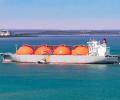
Urals and Sokol accounted for every 4 out of 5 barrels of Russian supplies to India last year.

United States President Donald Trump yet again claimed to have discussed with Prime Minister Narendra Modi about India's import of Russian oil, he told reporters on Tuesday after the Diwali celebrations at the Oval Office.

'Trump is likely being purposefully vague, hoping that this lack of clarity will pressure India, fearing the worst, to agree to scale back its imports of Russian oil.'

United States President Donald Trump on Tuesday boasted about India-US defence cooperation, claiming that India's order for 68 Apache attack helicopters was delayed by five years and that Prime Minister Narendra Modi personally raised concerns over the long delivery period during a meeting with him.
India's crude oil imports from Russia saw a marginal decline in September, but continued to account for over one-third of the country's total oil purchases, despite US pressure to curb the trade over concerns that it supports Moscow's war effort in Ukraine. India's crude imports in September were around 4.7 million barrels per day, up 220,000 bpd month-on-month and flat year-on-year.

Russian Foreign Minister Sergei Lavrov will visit Beijing to discuss the West Asia conflict, the Strait of Hormuz blockade, and bilateral relations with Chinese leaders.
As stringent sanctions imposed by the European Union and US are crippling business and trade, desperate Russian oil companies are offering huge discounts to India, provided a payment mechanism to bypass the SWIFT ban is quickly approved by the government. According to sources familiar with the development, Russian oil firms are offering 25-27 per cent discount to the dated Brent crude prices. State-run Rosneft is one the biggest oil companies that supply crude to India.

Moody's Ratings has reduced India's GDP growth forecast for 2026 to 6 per cent, citing subdued private consumption, capital formation, and industrial activity due to higher energy costs and global uncertainties.

Russia dominated Saudi Arabia in oil supplies as the world's fastest-growing major economy for fossil fuels in October, relegating the Kingdom to third place. Iraq was India's top oil supplier, according to the data from Vortexa. Saudi Arabia's decline in India's oil market has coincided with Russia's rise, and ironically occurred amid growing diplomatic ties between Riyadh and New Delhi. Saudi Crown Prince Mohammed bin Salman Al Saud is visiting India this month to meet Prime Minister Narendra Modi.

If the conflict continues for a prolonged period, State-run oil companies may have to review retail fuel prices accordingly.

The unexpected missile attack on a second India-bound ship carrying Russian crude, just three weeks after the first, has complicated matters for domestic refiners. India now counts the Vladimir Putin-led nation as its biggest oil supplier, according to Paris-based market intelligence agency Kpler, and these attacks come on top of US sanctions since December, where vessels that bring crude to India are facing heightened scrutiny. Panama-registered Pollux, which loaded crude at the Sheshkaris oil terminal in the Russian port of Novorossiysk on January 24, was scheduled to deliver the medium, sour Urals grade to Paradip port on February 28.

US Treasury Secretary Scott Bessent's remarks come ahead of a high-level summit where India and the European Union are expected to formally announce the conclusion of negotiations on a comprehensive free trade agreement.

India's merchandise exports experienced a slight decrease in February, while imports surged due to increased gold and silver purchases, leading to a widened trade deficit. The West Asia crisis is expected to further impact trade in the coming months.
A trade deal makes sense only if it is fair and reciprocal. If the cost is strategic dependence or loss of policy space, waiting is the wiser option, asserts Ajay Srivastava.

United States President Donald Trump has said Prime Minister Narendra Modi 'knew he was not happy' with India's purchases of Russian oil and that Washington, DC can raise tariffs on New Delhi 'very quickly'.

China has criticised the US blockade of the Strait of Hormuz, calling it a dangerous and irresponsible move, and urged Washington and Tehran to honour the ceasefire. Beijing also denied aiding Iran militarily and threatened countermeasures if the US imposes tariffs.
Come December, India may have to re-evaluate purchases of Russian oil if a price cap on crude oil proposed by the US and the European Union (EU) comes into effect. That impacts nearly a quarter of India's oil purchases that come at a discount, helping limit marketing losses for India's state refiners and enabling New Delhi to manage inflation by freezing pump prices of motor fuels. In September, India imported 1 million barrels a day or 24 per cent of its overall imports from Russia, which became the biggest supplier of oil to India.

Analysts predict India will face oil price volatility and macroeconomic effects due to the escalating Iran crisis, though the country's oil supply chain is not yet structurally insecure.
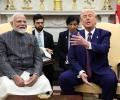
His assertion came after Trump claimed that his "friend" PM Modi has assured him that India would stop purchasing oil from Russia, a move he described as a big step toward increasing pressure on Moscow over its invasion of Ukraine.

There are enough people at the top decision-making level in Tehran who are still willing to negotiate, provided Trump can create the right setting for the negotiation to acquire a dynamic of its own, points out Ambassador M K Bhadrakumar.

India should not stay on the margins of this initiative. There should be a serious debate about what would be in India's best interests asserts former foreign secretary Shyam Saran.
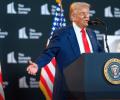
The comments come ahead of Trump's high-profile meeting with Russian President Vladimir Putin, scheduled for Friday in Anchorage, Alaska.

A 500 per cent tariff would effectively shut out India's goods and services exports to the US.

United States Senator Lindsey Graham on Sunday claimed that Indian Ambassador to the US Vinay Mohan Kwatra spoke to him last month about India buying less Russian oil and asked him to tell President Donald Trump to relieve the 25 per cent tariff.
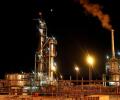
There is no payment problem for Russian crude, Petroleum and Natural Gas Minister Hardeep Singh Puri said on Wednesday. He said there is no proposal to cut retail fuel prices at the moment. Addressing a press conference, the minister said India enjoys a buyers' position and foreign suppliers are approaching Indian companies with offers to sell oil.
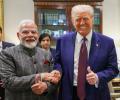
The agreement addresses non-tariff barriers and promotes increased trade in technology products and cooperation between the two countries.

The Indian rupee weakened against the US dollar due to rising crude oil prices, geopolitical tensions in the Middle East, and foreign fund outflows.
 © 2026 Rediff.com - Advertise with us - Disclaimer - Privacy Policy - Sitemap - Feedback - About us - Terms of use - Grievances